
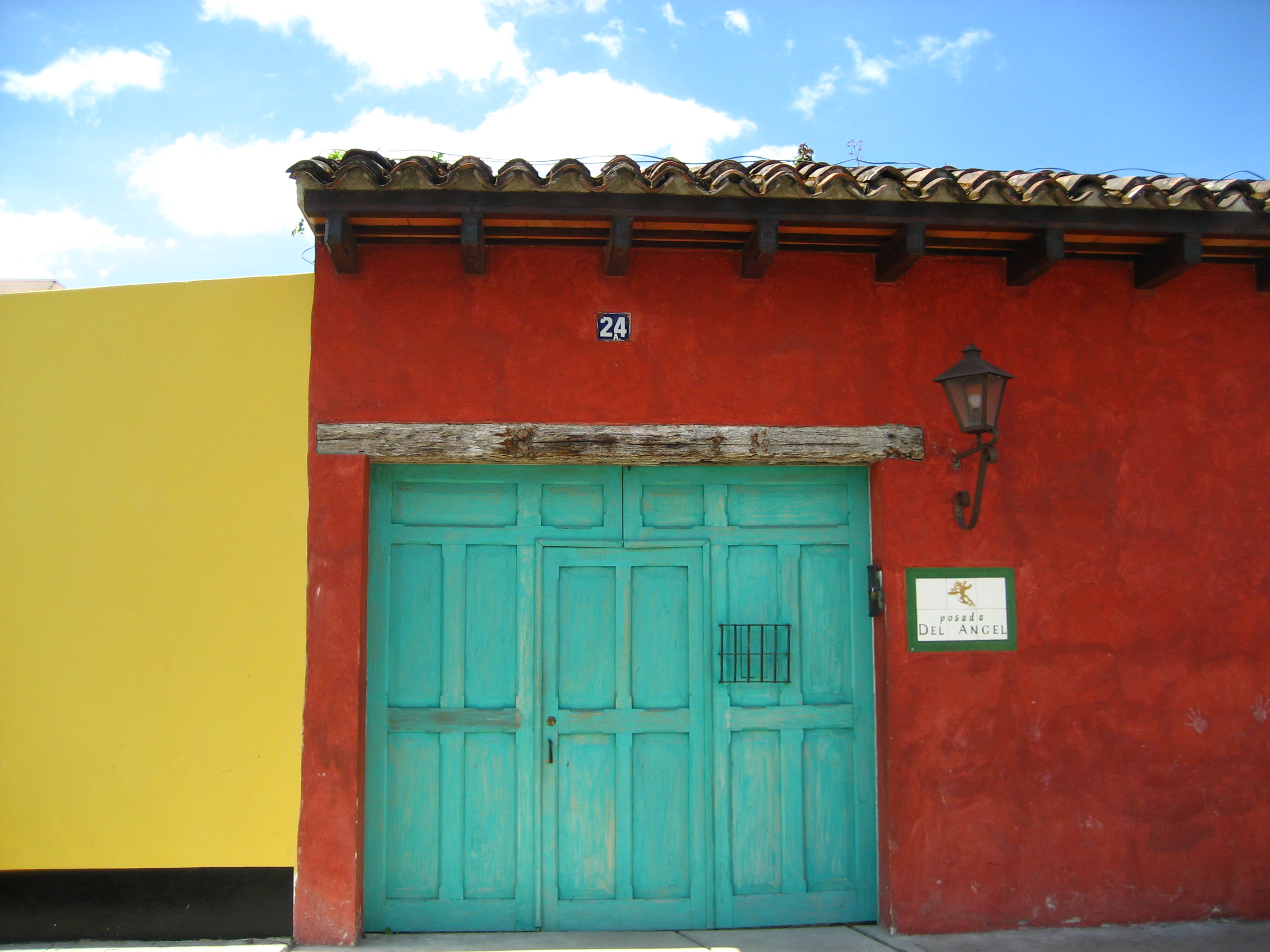
He was the first American President to sleep on Guatemalan soil. So says Becca.
He was the first American President to sleep on Guatemalan soil. So says Becca.
The scoop:
We started making bread! We’re doing a late afternoon batch of French Baguettes. Made from organic ingredients. Get ‘em while they’re hot!
Link.
Also, new savory bread pudding.
Curbed has already selected its Epic Comment of the Month — and it’s only February 6th!! An excerpt:
My friends and I are totally hoping to get a great apartment in the mission (that’s the neighborhood between valencia and dolores, and 24th and 15th–I read about it in C magazine’s travel section, they had a great article about it). I was hoping you guys could help. It needs to have parking (I totally need to learn how to ride public transportation, but until then, I just *can’t* move without my car ha ha!) We also need a big space, with hardwood floors, laundry, and some nice new appliances (oh, and a dishwasher–I totally *don’t* do dishes ha ha.) We want to be around authentic restaurants, that the locals would go to. Like Foreign Cinema. Or restaurants that are totally unique to the Mish and don’t exist anywhere else (like Luna Park). Dive Bars are a MUST! And we totally would love to live in an authentic live/work space. I will be working in the financial district.
Link. And be sure to read subsequent comments. Bree returns for more.
We lucked upon some of these at MSF a couple weeks ago, but forgot to mention them. Luckily, Thrillist reminded us that they’re now available at Elixir:
Basically the Doritos of Latin America, these light & crispy deep-fried swine skins’re made by the former Orson chef in his home kitchen (just down the street from Elixir), and’ll run you $3.50 a bag, $2.50 with a beer — savings you’re probably supposed to leave as a tip, unless you’re a greedy pig, and thus, a cannibal.
Link.
This week’s Bay Area print edition of The Onion — their Best of SF issue — includes a feature on Mission Street Food and other local piratical restaurateurs. Burrito Justice and Mission Mission get mentions. So if you’ve ever wanted to see our URLs in print, now’s your chance.
Go Mission!
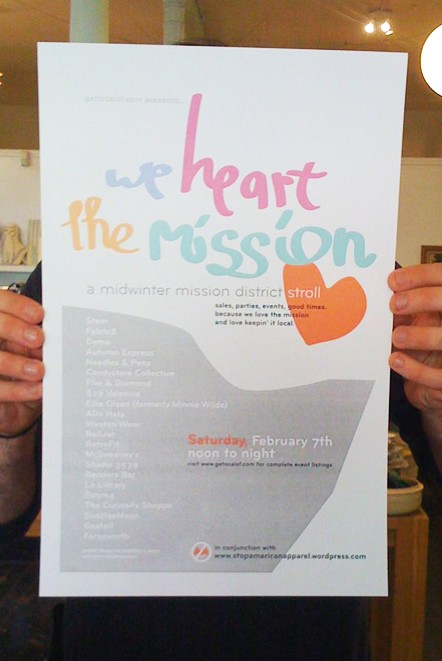
If you haven’t yet had the pleasure, tomorrow just might be the perfect day to check out the bevy of unique businesses that make up the delicate flower that is Valencia Street between 14th and 22nd Streets.
Special events and discounts await at every turn. For instance: McSweeney’s is having a sidewalk sale, Ritual is offering $2 double shots of espresso, Curiosity Shoppe is hosting a Valentine making workshop, and Gestalt is pouring $3 beers.
See GetLocalSF.com for handy-dandy map and complete details.
Thanks, mcas!
By G.:
I am certainly happy to live in one of the culturally shared geographies of the Mission. Having moved from Valencia to a house just off Garfield Square, the gentrification and de facto boundaries that surround Valencia are all the more apparent. Garfield Square is heavily used by Latino soccer players, white soccer players, and most importantly it is a staging ground for the dozens of homeless people that recycle the neighborhood’s bottles and cans. They cook here, sleep here, and sort their recyclables here. Underpriviliged youth attend after school programs in the Rec Center and as most people know, it is the final destination of the Dia de Los Muertos Parade. MOST importantly, which I bet very few people know, is that the funds to build the park were donated by none other than the Fisher Family, the owners of The GAP (gasp!). For those that think corporate America is the bane to the Mission’s existence, open your eyes.
Link.
By Emily and Kendra (via email)
We also attended the hearing [yesterday] as Mission residents and are happy that the commission voted to disapprove American Apparel opening a shop on Valencia St. Unfortunately, some of the public comments about the project and characterizations of the Mission upset us enough to speak up about some racism and classism that we witnessed.
Specifically, we found references to crime and the evolution of the Mission from an unsafe and undesirable place to a thriving business corridor as particularly offensive. Some comments, mostly from young white residents and business owners, referenced the idea that “we” made the neighborhood good, implicitly distinguishing themselves from other residents and businesses in the neighborhood, including the large Latino community.

Posts: 7810
Email: allanhough@gmail
Website: http://allanhough.bandcamp.com
"I joked that living in the Mission would be the end of me. And there were nights where it felt like the case.
One night I went out with my friend Allan to the bar that no one goes to on 16th Street, where I lost half my drink and money on the dance floor. Later we skated down 16th to Evelyn Lee, where I fell off my board and landed on my head as the 22 bus sped past behind me. A sobering moment. At the bar, I sulked and nursed my wounds until Allan put on Amy Winehouse’s 'Valerie.' We danced, he dipped me, and I felt better."
— My pal Valerie, writing about life in the Mission
 Allan Hough (7810)
 Andrew Sarkarati (1023)
 Vic Wong (772)
 Ariel Dovas (723)
 Kevin Montgomery (628)
 Helen Tseng (214)
 Kat Malinowska (170)
 Brittany Janis & Katie Cruz (104)
 Burrito Justice (99)
 Nick Pal (94)
 Erika Kali (87)
 Doctor Popular (50)
 Katie Ann (38)
 Mike Chino (35)
 Lael (27)
 Camille Ives (23)
 Caroline McCormick (23)
 Josh Widmann (23)
 Lizzy Courtois (18)
 Ginny Mies (15)
 Tomi Laine Clark (12)
 Jefferson McCarley (12)
 Becca (10)
 Andrew Dalton (9)
 Luke Spray (8)
 Cosmic Amanda (4)
 Emma Silvers (4)
 Jason Laska (3)
 Chris Bunting (3)
 Mollie C (3)
 David Cole (3)
 Miles Harrison (3)
 Ashleigh Cole (3)
 Jackie Potzdorf (1)
 Jen Gann (1)
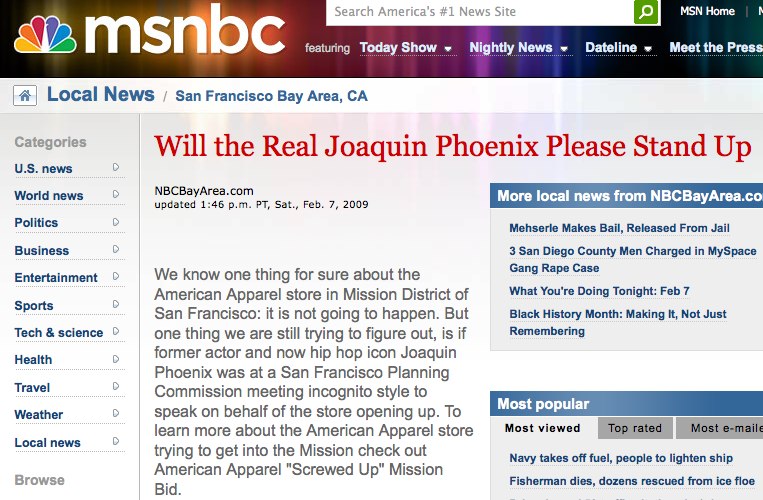




 We also attended the hearing [yesterday] as Mission residents and are happy that the commission voted to disapprove American Apparel opening a shop on Valencia St. Unfortunately, some of the public comments about the project and characterizations of the Mission upset us enough to speak up about some racism […]</p>
%5Bvia+%3Ca+href%3D%22http%3A%2F%2Fwww.missionmission.org%2F2009%2F02%2F06%2Fopinion-harness-this-energy-for-the-struggles-to-come%2F%22%3EMission+Mission%3C%2Fa%3E%5D&clickthru=http%3A%2F%2Fwww.missionmission.org%2F2009%2F02%2F06%2Fopinion-harness-this-energy-for-the-struggles-to-come%2F)